
What is Akashik?
One sentence
Akashik is a shared memory and coordination protocol for multi-agent AI systems.
The problem it solves
If you've built anything with multiple AI agents, you've felt this.
Your agents can call tools. They can talk to each other. But they can't remember. They can't share what they know. And when two agents arrive at contradictory conclusions, there's no standard way to catch it, reconcile it, or learn from it.
Every multi-agent system today carries its own ad-hoc memory layer — bespoke, fragile, and non-interoperable. Akashik is the protocol that replaces it.
Where it fits
Think of it as the missing layer in the agent stack:
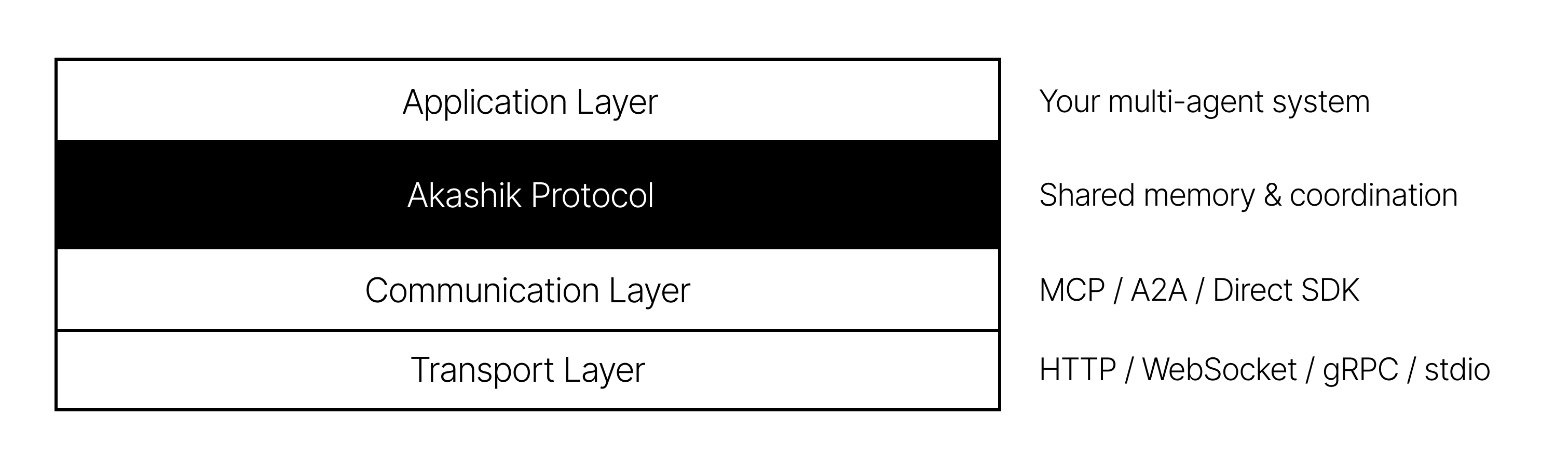
MCP handles agent-to-tool connections. A2A handles agent-to-agent communication. Akashik handles what agents share, how they stay coordinated, and how they resolve contradictions - without a central controller.
These aren't competing protocols. They're complementary layers of the same stack.
What it looks like
import { Field } from '@akashikprotocol/core'

const field = new Field()

const researcher = await field.register({ id: 'researcher-01', role: 'researcher' })
const strategist = await field.register({ id: 'strategist-01', role: 'strategist' })

// Researcher records a finding — intent is required
await researcher.record({
  type: 'finding',
  content: 'European SaaS market growing at 23% CAGR, reaching $4.2B by 2027',
  intent: { purpose: 'Validate market size for go-to-market strategy' }
})

// Strategist attunes — receives relevant context automatically
const context = await strategist.attune({ max_units: 10 })
// Returns the researcher's finding, ranked by relevance
// Every result includes WHY it was recorded, not just WHAT
That's Level 0. Two agents sharing memory with intent tracking. Under ten lines.
Three ideas that make it different
Intent is mandatory. You cannot write to the Akashik Field without explaining why. The intent field is required on every single write. Any agent — or any human — can look at any finding and immediately understand what question it was answering and why it matters. You get a reasoning chain for free.
Attunement, not search. Agents declare who they are — their role, their active task, their context budget — and the protocol figures out what's relevant and delivers it. Context finds the agent, not the other way around. Agents don't need to know what to ask for. They just need to show up.
Conflicts are expected. When two agents arrive at contradictory conclusions, Akashik detects it and gives you structured resolution paths — from simple last-write-wins to evidence-weighted decisions to flagging for human review. Conflicts aren't bugs. They're a natural part of multi-agent collaboration.
What Akashik is not
- Not a vector database — Akashik is a protocol, not an implementation. It defines the contract; you choose the storage.
- Not a message queue — agents share structured, intent-bearing context, not raw messages.
- Not a replacement for MCP or A2A — Akashik is the memory layer. MCP and A2A remain the tool and communication layers.